NOTE: Before starting, I just want to acknowledge that many Columbus Crew fans are understandably upset that this marquee home game was moved to Cleveland. I do address my own conflicted feelings near the end of this. I hope to have a few more pieces tangentially related to this past weekend’s match, but I wanted to put together an old school 5,000+ word Sirk’s Notebook since I could actually be there. Overkill? Sure. Then again, it always was.
So here’s an assortment of thoughts on the game, Cleveland’s soccer history as it ties into the Crew, Messi mania, OMFxG, a multi-sport Mr. Numbers Nerd, homecomings, Cleveland’s near miss with MLS in 2003, a journey down the rabbit hole of teams playing home games elsewhere, and whether this was all worth it. (I think/hope so?)
*******
For one afternoon, the Columbus Crew traded The Fortress for a factory. Unfortunately for them, it was the Factory of Sadness.
That sobriquet was bestowed upon Huntington Bank Field, home of the Cleveland Browns, by Cleveland comedian Mike Polk Jr. in 2011. Fourteen years later, the structure lived up to that billing in the Crew’s 1-0 loss to Inter Miami, in what was a battle of the two remaining unbeaten teams in Major League Soccer.
With the exception of the 2016 (and hopefully 2025) Cavaliers, sports heartache and disappointment are among Cleveland’s most robust industries. And it’s a rare occasion that a black & gold team puts in a losing shift at the Factory, but this was one of them, and that’s only because a win was actually the desired result this time.
That’s just how it goes here. Sorry.
Wait, I need to pause to be my own “well, actually” guy.
Well, actually, the Browns have won five of their last six home games against the Steelers, after winning just four of the 19 meetings in Cleveland prior to this current run.
Okay, so maybe my joke is trending toward outdated and the Crew fell victim to some changing black & gold mojo at the Factory. Regardless, the standings officially recorded it as an L in the Land.
THE CREW AND CLEVELAND
When the Crew announced this game and expressed a desire to grow their fanbase in Cleveland, my brain drew some immediate parallels that made the Columbus Crew a perfect MLS fit for Northeast Ohio soccer fans.
Of course, Columbus is the most proximate MLS team, and there is an established sporting relationship between the two cities. The Crew and Browns share common ownership. The Cleveland Guardians and Columbus Blue Jackets have their top minor league affiliate in the opposite city. The cities complement each other perfectly, with Cleveland being home to NFL, MLB, and NBA teams, while Columbus is home to NHL, MLS, and major NCAA teams. Between the two cities, that’s a complete major men’s sports set with no overlap. (And NCAA women in Columbus and some women’s pro sports on the way in Cleveland.)
As a Clevelander, I thought about how my hometown’s soccer zenith involved supporting an exciting yellow soccer team whose home games were played before large and loud crowds. The Columbus Crew are reminiscent of the 1980s Cleveland Force in that regard. (Plus, Force coach Timo Liekoski was the Crew’s original coach, and Force player Brian Bliss was an inaugural Crew player and later was the technical director for the Crew’s 2008 MLS Cup championship team.) I also thought about how Cleveland’s most successful team on the field resulted in three championships thanks to an explosive offense that made games so exhilarating to watch. The three-time MLS champion Columbus Crew are reminiscent of the three-time NPSL champion 1990s Cleveland Crunch in that regard. If you’re a Cleveland soccer fan of a certain age, the Columbus Crew are the Force and Crunch rolled into one, except they play outside.
And then there is the talent pipeline. The Crew have featured many Cleveland-area players over the years, starting with the U.S. National Soccer Hall of Fame goalkeeper Brad Friedel of Bay Village in 1996 and 1997, running through the Crew’s current Cleveland contingent of Darlington Nagbe (Lakewood), Sean Zawadzki (Olmsted Falls), and Evan Bush (Concord Township.) Recently retired, long-tenured fan favorite Josh Williams is from Copley, and there have been so many more Northeast Ohioans to wear the Black & Gold in the past. (Not to mention non-Crew MLS players from the area, such as MLS Cup champion Justin Morrow.)
For Cleveland soccer fans, there are ample reasons to love the Crew. Anecdotally, I have seen the Crew’s footprint grow here in recent years. It’s no longer a surprise to see a Crew jersey, t-shirt, jacket, or hat out in public, or to be behind a car with a Crew magnet on the back. Such sightings are far from ubiquitous, but it’s no longer like claiming to have seen Bigfoot.
MESSI MANIA
While the Crew have set their sights on growing their Northeast Ohio fanbase, thereby being the MLS club of choice for all but the Kentucky-adjacent areas of the state, it was Lionel Messi, widely considered to be the greatest player in the history of the sport, who was the attraction that warranted a venue more than three times the capacity of Lower.com Field. Moving a Crew home game to Cleveland would have made no sense without a draw of Messi’s magnitude, so the Crew took their shot.
The end result was an announced crowd of 60,614, by far the largest crowd to see a soccer game in Cleveland’s history. And it was technically, asterisk-ly the largest home game attendance in Crew history. (The crowd of 31,550 that saw the Crew beat the MetroStars 2-0 at the Horseshoe on September 15, 1996, is the Hank Aaron of Crew single-game home attendance records.)

In an ideal world, Messi would have dazzled the crowd with a scintillating hat trick, only for the Crew to win 4-3 on one of those Darlington Nagbe goal-of-the-year candidates he launches every few years. I can’t imagine it will come as a shock to anyone that the world is not in fact perfect, so the Crew lost 1-0 in a game in which Messi barely broke a sweat.
He had a few moments. He sprung a counterattack, hit a few nice passes to switch the attack, had a good scoring chance blocked by Crew defender Malte Amundsen, did a whirling, reversing course dipsy-doodle amidst five Crew players in the box to get off a deflected shot, and most memorably, drilled a long-range blast barely wide of the post just before halftime, although it looked like Crew goalkeeper Patrick Schulte would have pawed the ball aside if it had managed to curl on frame. Also, Messi won a foul by grabbing his face and falling to the ground despite never being touched by Max Arfsten. But other than that, he mostly did that Messi thing where he just walks around the field, lulling everyone into complacency, waiting for the right opportunity to burst forth and do astonishing greatest-of-all-time things.
That he didn’t could be attributed to a couple of factors. First, the Crew defended him well and worked hard to deny him the ball. Olmsted Falls native Sean Zawadzki took the lion’s share of that role.
“Messi is Messi,” said Crew coach Wilfried Nancy, “but I think that we controlled him well. He had small chances… We talk about Messi, and again I respect him, but I think that Sean Zawadzki, what he did on the 1v1 against him and also against (Luis) Suarez, knowing that they were really good to combine, to make the late run, and so on. I think we did a good job defensively against this team, but it was not enough (to win.)”
Zawadzki was pleased with how he and his teammates defended Messi, knowing the problems he can cause to anyone and everyone and any and every level around the world.
“It’s very difficult,” Zawadzki said. “You know, you see he pops up in these little half spaces, and once he turns, starts running at you, you never know what he’s going to pull off. So in the game, it’s trying to limit those opportunities for him to turn it and run at the back line to pick those passes that he’s so great at doing, and I thought we did well with that. He had some moments here and there to do that, but I thought we limited his ability to pick those passes.”
Per Football Reference, Messi finished with only 46 touches and 37 passes, both of which were season lows in any game he had started. He also completed just 75.7% of those passes, which was slightly below his season average. (That may seem like a low percentage, but Messi is usually attempting creative attacking passes rather than mundane possession passes.)
Another reason for Messi’s low utilization was the game itself. The Crew completely dominated the ball in the second half as Miami dropped deeper and deeper to hold the Crew at bay. This largely left Messi to wander around alone up top, waiting for his moment to spearhead a counterattack that would seal the game. Fans around MLS and the world have seen it happen time and time again. However, the Crew were so good at retaining and reclaiming possession in the second half that Messi’s opportunity never materialized.
For those in the stands wearing pink jerseys, they saw Miami get a win, if that’s what they even cared about. In many cases, the pink jersey signified they primarily cared about seeing moments of breathtaking magic from the great Lionel Messi. Those were few and far between.
OMFxG
When it came to chances, the Crew expected-goaled the Herons into oblivion, although Miami out-actual-goaled them 1-0. The details vary slightly by each individual data service, but the consensus was that based on the shots taken, the Crew should have won 3-1. And that was based on the shots the Crew took, never mind the chances where they couldn’t pull the trigger. The number of times the ball pinged around in the Miami box without someone even taking a poke at it had old Cleveland Force fans pining for the days a premier garbage man like Craig Allen.
New acquisition Daniel Gazdag, making his first start for the Crew, had multiple good chances and accounted for nearly half of the goalless Crew’s expected goals.
“I had some chances,” Gazdag said, “but at this point, it’s pretty annoying. It’s a positive thing I was able to get chances, but obviously I will like to score in the next game. I will work for that.”
Gazdag was far from the only one ruing missed opportunities. Diego Rossi (skied wide) and Max Arfsten (saved) had good chances they’d want back as well.
“Collectively, we just need to be better in front of goal and we all know that,” Arfsten said. “But I think it’s better to be positive about the fact that we are creating the chances, we are dominating these games, and especially against a quality opponent like Miami. So just got to try and be positive and move forward.”
Nancy felt it was important to separate the process from the result.
“If we put the result on the side because this is the result, the performance was good, but we missed certain things to win the game,” he said.
Before commenting on specific problems, Nancy wanted a chance to study what happened.
“I have to watch the game to see if this is technique, timing, or decision making,” he said. “At the end of the day, we had many chances for sure.”
A CROSS AND A CROSS-REFERENCE WIN IT FOR MIAMI
Miami’s goal in the 30th minute was a thing of beauty. Luis Suarez played a long, switching pass to Marcelo Weigandt, who was racing up the right wing. Weigandt ripped a first-time cross into the box and Benjamin Cremaschi uncorked a diving header that redirected the ball into the upper side netting at the far post.
Shortly thereafter, my wife texted me, “Apple guys mentioned Brian McBride did headers like that.”
I texted back, “He did.”
For all the hype about Miami’s global legend, it was a 20-year-old evoking a Columbus Crew legend that did the Crew in.
MR. NUMBERS NERD: MULTI-SPORT VISITS
There has been a recent run of multi-sport visits to Ohio cities.
On February 22, Chicago sent its Blackhawks and Fire to Columbus to simultaneously play right down the street from each other. The Blue Jackets defeated the Blackhawks, 5-1, and the Crew defeated the Fire, 4-2, for a Columbus sweep.
On April 8, Chicago tried again and sent its White Sox and Bulls to Cleveland to play right next door to each other. The Guardians defeated the White Sox, 1-0, and the Cavaliers defeated the Bulls, 135-113, for a Cleveland sweep.
And now on the weekend of April 19-20, Miami sent its Herons and Heat to Cleveland to face the Crew and Cavs. The Herons beat the Crew 1-0 and the Cavs beat the Heat 121-100. The series resulted in a split, but Ohio won 121-101 on aggregate.
HOMECOMINGS
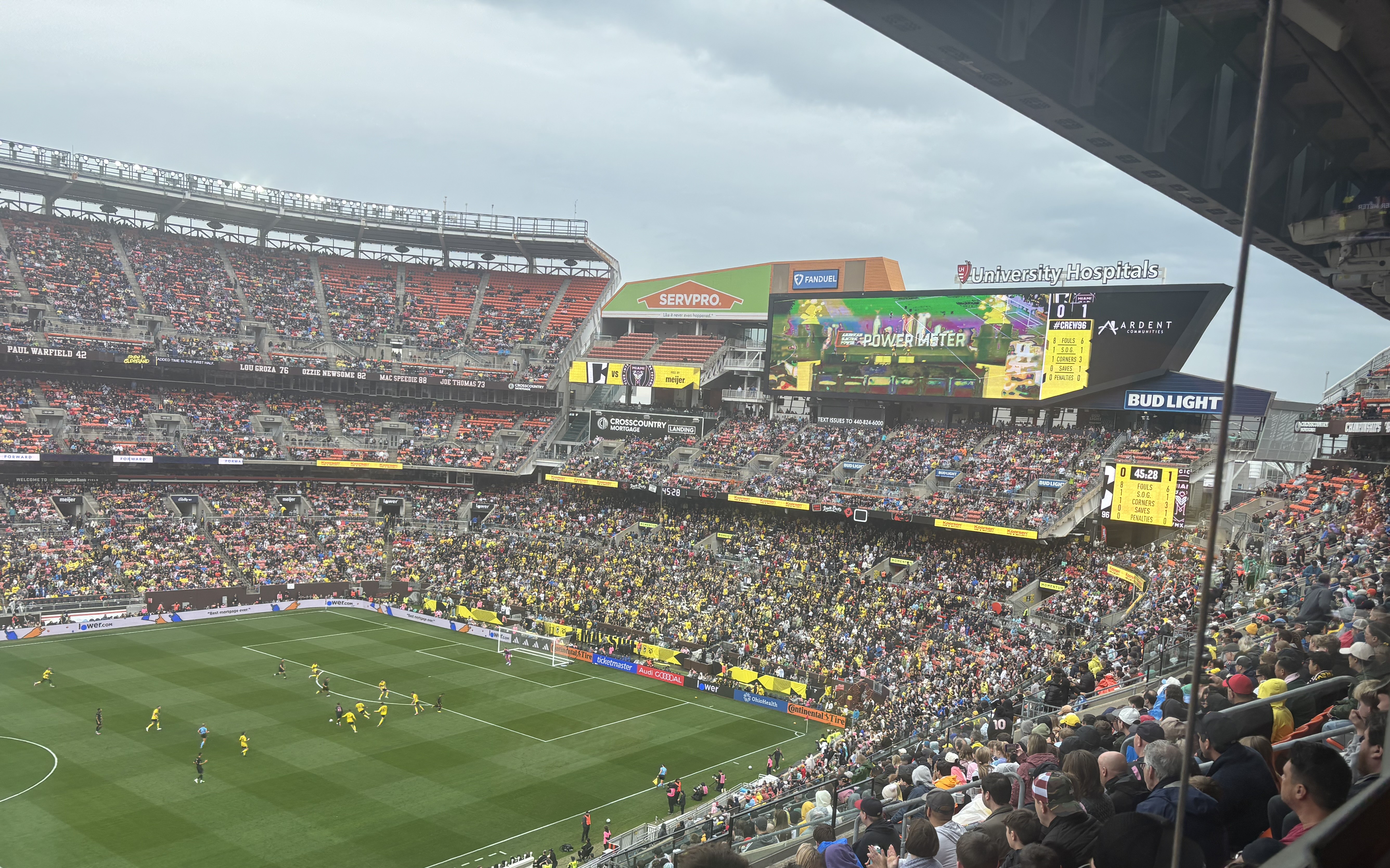
However one feels about the match being moved to Cleveland, it made for an incredible experience for Nagbe and Zawadzki, who got to play in front of a huge crowd that included friends and family in their hometown stadium.
“It was great,” Nagbe said. “Honestly, it was better than I thought it was going to be. The fans packed it. A lot of Columbus fans. I didn’t know how it would be with Miami and Messi, obviously the draw that he is. Just thankful for the fans showing up, thankful for the city of Cleveland, and it was a great experience… I wish we would have gotten the win and just enjoy it a little bit more, but it was such a great experience. Watching the Browns here and growing up a couple miles from here, so to be here and be able to captain the Crew, play a home game here in front of these fans, in front of our friends that made it (up) from Columbus, it was definitely a special evening.”
“It’s a surreal moment for me,” said Zawadzki. “Being a little kid in the stands (at Browns games) with my parents and my grandparents, and now fast forward 15 plus years, and I’m on the field playing in my hometown in front of my family and friends and in front of all the Crew supporters. So it means so much to me. Obviously, would like the result to be different, but albeit, it was a great, surreal, surreal moment for me.”
Zawadzki made a special point to appreciate the Crew fans who made the trip to Cleveland.
“I thought the traveling Crew fans coming from Columbus were phenomenal,” he said. “Obviously, it’s a lot for them to come up here and it just goes to show how dedicated they are and how much they support us. We’re really grateful for that. You know, there’s been all of this talk, but we’re glad that they were able to be here and support us. It went a long way. It kept us pushing, kept us fighting for these opportunities, to create these chances late in the game that we had. Albeit, we didn’t score, but they definitely gave us extra energy to keep going.”
THE NON-CLEVELANDERS REACT
The game obviously had extra meaning for Nagbe and Zawadzki, but everyone else seemed to enjoy the novelty of the experience.
“It was good,” Nancy said. “Good because it was loud. Also, it was not easy because when you play at home, but you also have fans from the opposite team. I like the fact that we pushed, and we reversed the fans [who came to see Messi]. Good experience. Good for the club. Good for everyone. We were missing the win. The pitch was good.”
“It was awesome,” added Patrick Schulte. “The crowd was into it the whole 90 minutes. 90-plus. They were behind us the whole time, so that was awesome to feel, but yeah, wish we could have gotten it done for them.”
Max Arfsten said it was the largest crowd he had ever experienced as a player.
“I certainly felt the love,” he said. “We all felt the love from the fans who traveled and the ones who just came from Cleveland. I saw 60,000, so we were super buzzed for that. And, yeah, I think at the end of the day, just be proud of the show-out. Obviously, it’s a different venue. We had to travel, but I felt the love from the fans for sure, like I felt the energy was there. I felt, obviously, there’s people who want to watch Messi, but I still feel like there were fans for us.”
Daniel Gazdag made his Crew debut in St. Louis last week, then made his home debut…in Cleveland. The arrangement had to be more disruptive for him than most as he attempts to get settled in Columbus.
“Yeah, it was a little bit weird to play a home game away from home, a little bit like playing away,” Gazdag said. “But obviously it was a very good atmosphere here. Thank you to the fans that came out today. It was really good to play in this nice stadium.”
THIS GAME COULD’VE BEEN IN CINCINNATI
Long before there was Hell is Real, there was almost Grandpa’s Cheesebarn. Once upon a time, Ohio’s highway sign derby would have involved the northern leg of Interstate 71, not the southern leg. In November 2003, MLS announced that former Cleveland Force owner Bart Wolstein signed a letter of intent to bring an expansion team to Cleveland. Had the effort succeeded, the Crew might be trying to grow their Cincinnati fanbase now as the Fusslads perhaps wouldn’t have been permitted to be a third Ohio MLS team.
“(Wolstein) represents the best in what we look for in an MLS owner,” Commissioner Don Garber told the assembled national soccer media while making the Cleveland announcement in advance of MLS Cup 2003.
In early February 2004, Garber elaborated to the Elyria Chronicle-Telegram. “Cleveland has the three elements in place,” he said. “It’s a great market with a history of support for its indoor team. (Wolstein’s Cleveland Force, which outdrew the NBA’s Cavaliers five straight years at the Richfield Coliseum in the 1980s, followed by the three-time champion Cleveland Crunch in the 1990s.) It has a great owner in Bart Wolstein, a guy who believes in the sport. Bart is committed to a soccer-specific stadium, one that will stand out among the great stadiums anywhere.”
By late March 2004, the stadium situation remained unresolved, although the focus had shifted to the idea of a mixed-use stadium complex in northern Summit County off Route 8. The initial plan was to build a downtown stadium on the very same plot of land that Cleveland Soccer Group currently intends to build its stadium for MLS Next Pro and WPSL Pro.
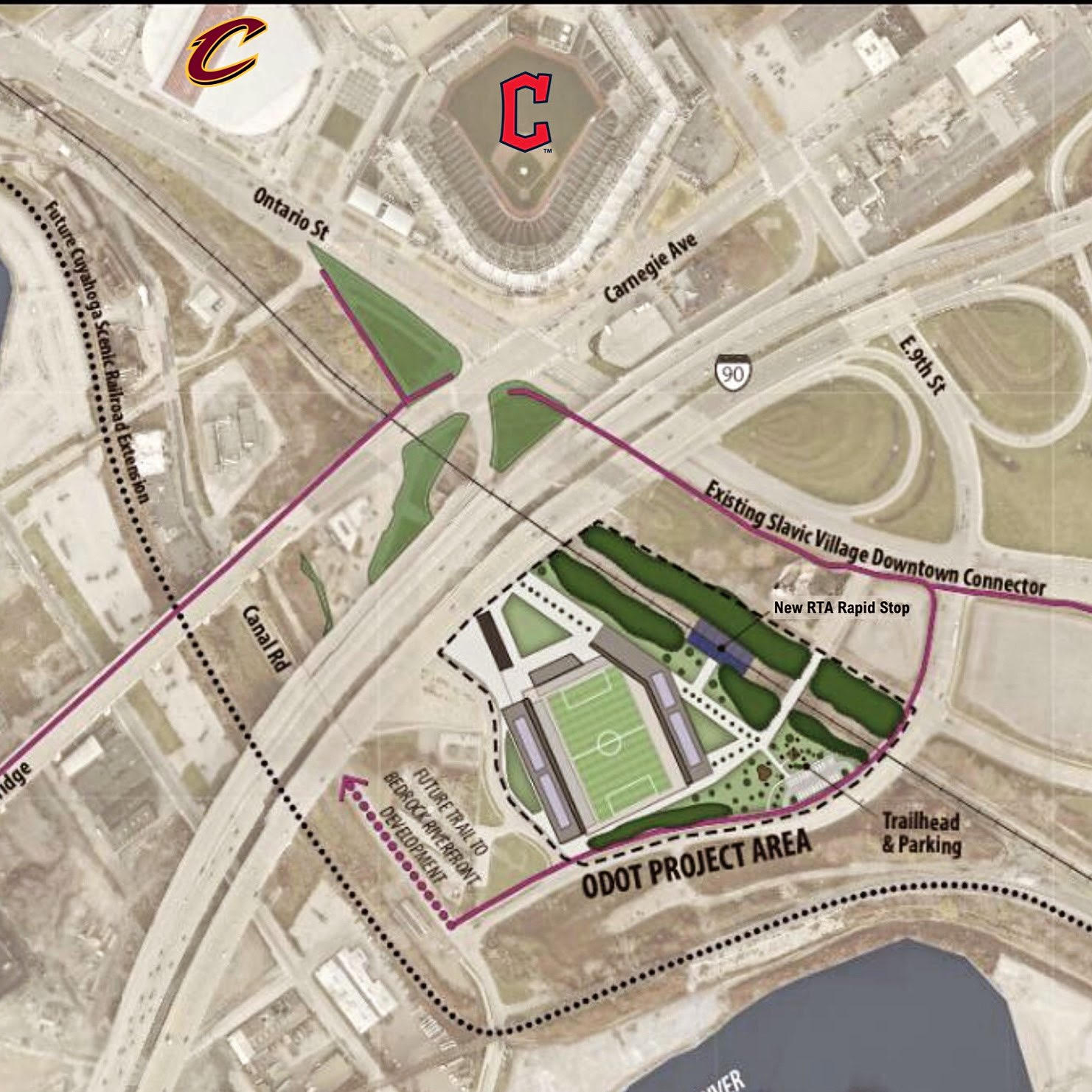
However, the city balked at any financial support, suggesting that Wolstein’s MLS team should play in the Browns’ stadium so the taxpayer-funded edifice would get more use beyond ten Browns events per year. This was at a time when MLS was expressly trying to move out of NFL stadiums and into smaller soccer-specific venues like the pioneering structure Lamar Hunt had recently built in Columbus for the Crew.
Wolstein dismissed the lakefront suggestion out of hand. “It shouldn’t even be discussed,” he told the Plain Dealer. “You can’t play this game in a 75,000-seat stadium and you can’t play in a stadium you don’t own.”
Those were among the last public comments Bart Wolstein made about his MLS bid. He passed away on May 17, 2004, nearly six months after the initial expansion announcement. Cleveland’s 2005 expansion slot was subsequently awarded to Salt Lake City.
I thought of Bart Wolstein when I looked at a crowd of over 60,000 people attending an MLS game in the home of the Cleveland Browns. I mean that in the sense that there was finally an MLS game being played in Cleveland over two decades later. Wolstein was right about the Browns stadium, of course. Given the state of soccer and MLS at that time, the stadium would have been a thoroughly unsuitable venue, both on and off the field, for a 2005 MLS expansion team. And the reasons it made sense to host a special-event MLS game there 20 years later were inconceivable back then and completely inapplicable to his efforts. But for just one day, MLS was actually in Cleveland, so it made me think of Bart Wolstein and what he tried to accomplish for soccer here.
So that’s a quick version of how MLS slipped through Cleveland’s grasp two decades ago. (A more thorough and detailed telling of the twists and turns in that tale will appear in my upcoming book on the Cleveland Force. I’m hoping to have it out in late 2025 or early 2026.)
HOMES AWAY FROM HOME
Ah, a Notebook tradition where something sends me down the rabbit hole… and if you were opposed to the Cleveland game, please know that this isn’t meant to sway you or invalidate your feelings. This is just another instance of me following a random thread in my brain and sharing.
The rabbit hole in this instance is willingly playing a home game in your territory, but not your true home. And I don’t mean natural disaster-related dislocations, or even moving to a larger stadium in your immediate market, like the LA Galaxy and LAFC playing an El Traffico game at the Rose Bowl, or an NHL Stadium Series game, like the Blue Jackets playing at the Horseshoe. I mean intentionally attempting to extend your audience’s range by relocating a home game hours away in your territory, as the Crew did in Cleveland.
There was one overtly-named example I immediately thought of, which was the Kansas City – Omaha Kings of the NBA. When the Cincinnati Royals relocated west to KC in 1972, they had the itsy-bitsy problem of having no NBA-sized arena to play in. Municipal Auditorium held only 7,000 fans, so the owners committed to playing 12-15 home games per year in Omaha’s 9,300-seat Civic Auditorium until a new arena could be built in KC. The team’s name was changed accordingly, and over the course of three seasons, the Kansas City–Omaha Kings went 27-18 when playing four hours to the north in Nebraska, which was far better than their record in Kansas City. Alas, when Kemper Arena was built, Omaha was cast aside. In 1985, Kansas City was too, as the team relocated to Sacramento.
But the concept of a team playing a home game elsewhere in its market area, even if it’s many hours away, is not a new one. Not even to the state of Ohio. In the 1960s, to cover the Ohio market, the Cincinnati Royals played several home games a year nearly four hours away at the Cleveland Arena before Cleveland was awarded the Cavaliers in 1970.
Okay, it may seem like the Royals-Kings franchise had a fetish for sharing home dates with cities four hours away and that I am exploiting that, but I assure you far more successful teams also utilized the practice. It’s not even a truly old-timey idea. In my lifetime, which, well, is admittedly now bordering on old-timey, two of the most fabled teams in American sports, the Green Bay Packers and Boston Celtics, routinely split their home schedules well into the 1990s.
For more than 60 years, the Packers played 2-4 home games per season nearly two hours away in Milwaukee. It was a consistent three games per year in the ‘80s and ‘90s. Milwaukee even hosted a playoff game in 1967. For the Packers, it was a matter of economics. It was not until extensive renovations were completed to Lambeau Field, coupled with the growing pot of NFL television money, that the Packers were able to play in Green Bay on a full-time basis beginning in 1995. (Even now, the Packers split their season tickets into two completely distinct packages. As a thank you for their decades of hosting and support, Milwaukee-area residents get their own package for the second and fifth home games of the season in Green Bay, while Green Bay-area residents get a package for the other six games. Each package gets an extra game on an alternating basis in years where the Packers have nine home games.)
The Boston Celtics did not need to play games two hours away in Hartford for survival purposes. They did it to keep Connecticut in their column, preventing encroachment by the New York Knicks into southern New England. For two decades, the Celtics averaged more than three home games per year in Hartford. The fans in Connecticut saw four different NBA champions—1976, 1981, 1984, and 1986—play multiple home games there. Yes, the Larry Bird Celtics played three or so home games two hours away each and every season. The last game in Hartford was in 1995. When the Celtics opened their new rent-free arena and controlled all revenues, it was no longer financially advantageous to rent an arena in Hartford. Suddenly, the Knicks ceased to be a concern.
I know of no plans to franchise-share the Crew with Cleveland, which wouldn’t make sense to me on multiple levels, so that’s not what this is about. But it’s crazy to think that iconic teams like the Green Bay Packers and Boston Celtics were playing multiple home games two hours away well into the 1990s and it was perfectly normal.
A special event Columbus Crew game in Cleveland was somehow less of a disruption than what Larry Bird, Robert Parish, and Kevin McHale went through while winning NBA titles for the Boston freakin’ Celtics.
That’s wild.
WAS IT WORTH IT?
From the moment Huntington Bank Field was announced as the location for the highly-anticipated home match against Lionel Messi and Inter Miami, the move stirred lots of emotions. A portion of the Columbus fanbase felt, understandably and justifiably, that one of the top games of the season was being taken away from Columbus. There’s no arguing that point. Their anger and disappointment are valid.
But moving the game was also an opportunity to put the Crew in front of a large soccer community within its natural (and contractual) territory. Even if Messi was the headliner, what better advertisement for the Crew in Northeast Ohio than bringing a matchup between two top teams directly to the masses?
And with Messi, that’s the only way you can capitalize on his presence in the league. When David Beckham came to MLS, he was on all the late-night talk shows and did all the local media wherever he went. he was everywhere. Messi doesn’t do talk shows. He doesn’t do press conferences. He certainly doesn’t do press gaggles on the training field like Beckham at Obetz. Even Messi’s gameday movements within the bowels of a stadium receive the security detail of a foreign head of state. The only opportunity to glimpse him is for (hopefully) 90 minutes on the field on match day. That, and the occasional television commercial where he plays beach soccer while waiting for his Michelob Ultra or eats some potato chips while people sing “Oh Lay’s” to the ole song.
Had this been Messi’s first and/or only appearance against the Crew, moving the game to Cleveland would have been unconscionable. Columbus deserves to eat first, and indeed, Messi appeared at Lower.com Field last October, scoring two goals in a 3-2 Miami win that clinched the 2024 Supporters’ Shield over the runner-up Crew.
The second time around, it was an opportunity to expand access to Messi tickets and to put the Crew in front of a lot of new eyeballs. Two Messi appearances allowed for two different approaches. The first time was the true Crew experience. The second time was the cash/marketing bonanza. Whether it was appropriate to even attempt to balance those competing concerns is up to each individual, but there was some semblance of balance and in the correct order.
I know the match was classified as a cynical cash grab by some, and there’s no doubt making gobs of money was a critical part of the calculus, but I kept one eye on the crowd. From what I could tell, the crowd consisted of a few different types of people. There were Crew fans who were only about the Crew and would have been happy if Messi had to Pachuca his way to the toilet all afternoon and couldn’t play, thereby helping the Crew’s chances of winning. There were people rooting only for Messi/Miami, including one particularly ardent fellow right in front of my press box seat, but those fans didn’t seem to be a huge factor within my line of sight. There were people in Messi gear who cheered the Crew in addition to Messi, and there were just random people with no gear who were there for the event and cheered any action regardless of team, which meant they largely cheered for the Crew and all those chances.
It would be hard for me to assign percentages based on my limited view of the crowd, but it seemed like a loud and diversified throng that simultaneously leaned pro-Messi and pro-Columbus. That’s how it goes when a worldwide icon is in the building.
At one point, my colleague Charlie Hatch pointed to a sight that was emblematic of what I was feeling about the crowd. It was a father and son. Dad was in a blue and white #10 Messi Argentina jersey. Son was in a pink #10 Messi Miami jersey. As they walked out to the aisle at halftime, the dad carried a clear team store bag. Inside the bag was yellow swag. Not everything about this game was as black and white (or black and pink) as it appeared.
It is currently impossible to know the long-term effects of this event, but there were two risks and one benefit that were immediately measurable. There was the reputational risk (and therefore financial risk) of upsetting some of the club’s most loyal supporters back home in Columbus. Also, there was the competitive risk of playing a home game two hours away, which meant that it was operationally a road game for the team, regardless of crowd composition. On the flip side, there was the immediate benefit of making gobs of money from a huge crowd.
In the short term, we know the Crew organization angered some of the club’s most loyal supporters, we know the Crew lost the game, and we know the Crew made gobs of money.
What can’t be determined this week is whether the non-cash benefits outweighed the risks. How many people got their first taste, or a rare taste, of pro soccer and now want more? Think back to the first Crew game or pro soccer game you ever attended, and how it made you feel. For a lot of people in Northeast Ohio, this may have been that game. And if they thought this was fun, wait until they check out a game at a sold-out Lower.com Field with the full breadth and power of the Columbus fanbase behind the team.
Max Arfsten was optimistic that that the special match in Cleveland will gain the team more fans in Northeast Ohio.
“I think some people probably got a chance to see us for the first time, or maybe have never seen the Columbus Crew play before,” he said. “Just being in a different city, having so many more people being able to watch the game, I think for sure it opened some eyes, and hopefully they enjoyed the way we play. I know the result didn’t go our way, but I still feel like we played our brand of footy.”
The Crew don’t currently have empty seats to fill at the LDC Death Star, but they undoubtedly have other measurables in mind, from Apple subscriptions to season ticket waiting lists to merchandise sales to sponsorships and so on and so forth. So maybe this strengthens the club in other ways, and maybe this windfall gets directed back into the team in terms of a big-money signing this summer.
And maybe, irrespective of the Crew, this strengthens the game in Cleveland. Even if many in the crowd can’t make it to a game in Columbus, maybe they will not only follow the Crew from afar, but will also support the new MLS Next Pro and WPSL Pro teams coming to Cleveland now that they’ve had a taste of pro soccer in person. Maybe the next Darlington Nagbe or Sean Zawadzki felt the spark of inspiration by seeing this game in front of a big crowd and will be suiting up for the Crew 15 years from now.
In a hot-take world, sometimes it seems impossible to allow one’s self to feel conflicted about anything. I was conflicted about this match. I didn’t like that it was moved from Columbus, and I empathize with the Crew fans who were upset by it, but I was thrilled for the soccer fans of Cleveland and what this could conceivably do for the Crew and for Northeast Ohio. It’s been fun to see Crew fandom growing around here, and there’s a lot more non-Crew soccer on the way. And hey, it made for a memorable one-game experience for Darlington Nagbe. I can find room in my heart to be happy about that for a Crew legend.
And selfishly, it may be the only Crew game I will be able to attend this year, so I savored every second of it.
So part of me dislikes that it happened, but I also get why it happened. And since it was happening no matter what I thought, I was excited for the experience for my hometown and am hopeful that the Columbus Crew will become even more Massive as a result, and that the game will also serve as an additional catalyst for the success of Cleveland’s own pro soccer efforts in the South Gateway district.
I hope this game works out for the best for everyone in the future. A future with the Crew selling out games and winning more trophies in Columbus, and Cleveland thriving in a new soccer stadium for its men’s and women’s teams while also being a little more Massive from afar.
I love Columbus and the Crew. I love Cleveland and soccer. Sometimes love is complicated. Massive love to all.
Questions? Comments? Wish the Crew would have trounced a Miami team at a Great Lakes NFL stadium like the Ohio Bobcats did in December? Feel free to write at sirk65@yahoo.com or via twitter (rarely) or Bluesky @stevesirk.
 Sirkbook.com