This morning, Cleveland Soccer Group unveiled the crest and identity of its MLS Next Pro team, Forest City Cleveland.
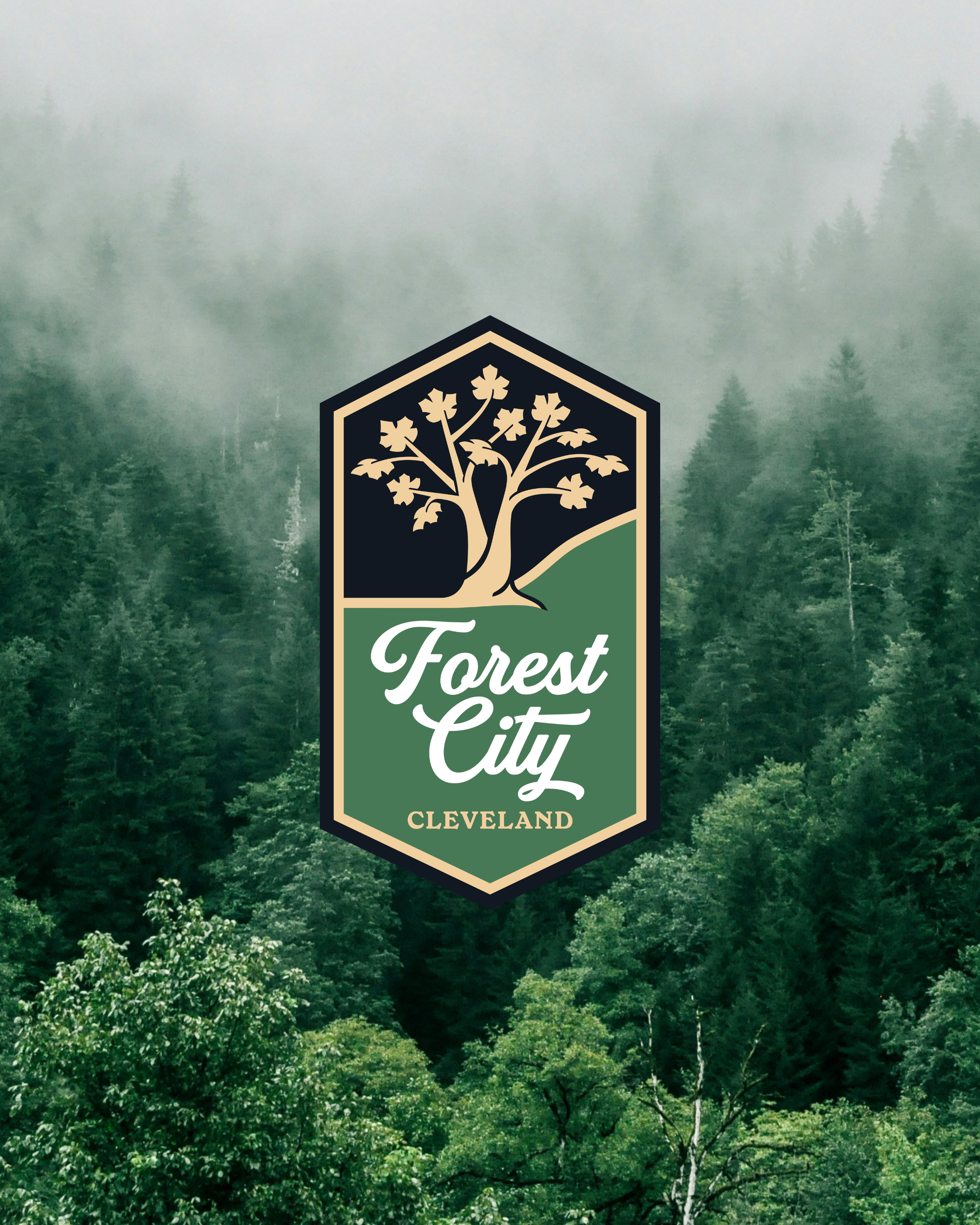
There will surely be plenty of chatter today about how it looks, with the art deco hexagon, and the color palette, and the tree, and the script / typeface, and the obligatory explainer graphic where the part of the crest that resembles Ohio represents Ohio, and so on. There will be commentary on specific design elements, and there are surely people far more qualified than I to dig into the nitty gritty of artistic composition.
I only care about what it makes me feel.
*****
Growing up in Euclid, our house was protected by several mighty and mature oak trees. If you were a tree-hugger, you’d need to recruit at least two friends to give those oaks a proper embrace. We had a few other varieties as well. I can’t remember the exact count, but it was roughly a dozen full-grown trees crammed into our lot. Our home did not have air conditioning, but nary a molecule of that house was touched by direct sunlight during the leafy season.
It got better. Just a few hundred feet from our front door was a substantial undeveloped tract of wooded land with a deep ravine, a small creek, and worn dirt walking paths made from years of neighborhood trampling. You could use the woods to navigate from our neighborhood all the way down to Euclid Avenue, which bustled off in the distance a long way below. Our woods was not a park, so it did not attract outside visitors. It was our own private paradise.
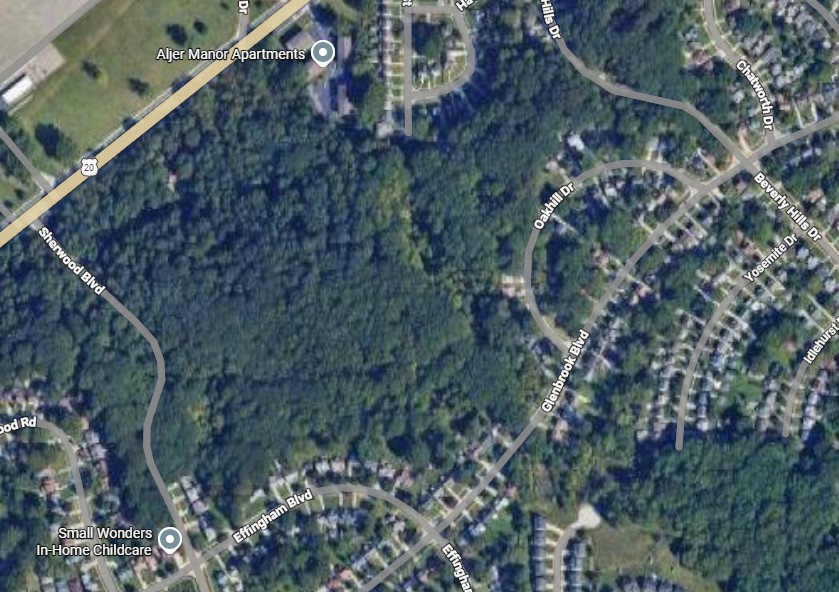
A half mile away, crossing into Richmond Heights off Chardon Road, one could use trees as momentum-breaking way stations to descend a deep, steep embankment into Euclid Creek. Not the Metropark, just untouched woods and creek. You’d have it all to yourself. Of course, if you had ample time for creeking, it was fun to follow its snaking path all the way into the Metroparks’ Euclid Creek Reservation. More creek. More woods. Just official and used by everyone.
I grew up in an urban inner-ring suburb, bisected by an interstate highway and railroad tracks, with manufacturing plants and a major shopping mall, and yet within easy walking distance, I had multiple options to fully lose myself in a secluded, forested oasis of my choosing.
*****
Naming a sports team is fraught endeavor and there is immense pressure to get it right. There are many paths to the finish line. Cleveland’s football team was named after its first coach. Cleveland’s basketball name was chosen from a name-the-team contest, with the winning entry submitted by the father of future MLB pitcher Brett Tomko. Cleveland’s baseball team is now on its fifth name, after Blues, Bronchos, Naps, and Indians. Of the three major league sports teams, Guardians is the only name that connects with Cleveland in some way.
Cleveland’s soccer history is littered with random names. The NASL’s Cleveland Stokers were so named because the team started as an imported summer team from English club Stoke City. The Cleveland Cobras went for alliteration like the Cavaliers. The Cleveland Force chose a fad name associated with a hit movie at the time of their launch. The Cleveland Crunch was a name decided at a weekend retreat hosted by GM Al Miller, where friends sat around drinking wine and blurting out possible names until Miller heard one he wanted to run with. Former Force and Crunch midfielder Mike Sweeney had a team here called the Cleveland Caps, short for Whitecaps, which is the team in his native Vancouver. The USL’s Cleveland City Stars were named that because…I dunno. During their brief existence, I never even figured out if they were the Cleveland “City Stars” or the “Cleveland City” Stars.
From the beginning, Cleveland Soccer Group set out to do things differently. They solicited names from the public and received several hundred suggestions. But more than that, they went deep with people. Chief Marketing Officer Gina Prodan Kelly (a fellow native Euclidean, though much closer to Lake Erie than my wooded hills) held focus groups and informal personal conversations with more than 3,000 people. What she wanted to know went well beyond name suggestions. She wanted to know what words came to mind when thinking of Cleveland, what people were proud of, and just as importantly, what names and themes should be avoided. For example, it became clear that people were sick of Cleveland being defined as some tough, gritty, industrial city, and they definitely didn’t want the team to have anything to do with worn-out imagery of rock & roll guitars.
The point of all this wasn’t to simply harvest name suggestions and then pick the one that ownership liked best. The intention from the beginning was to listen to Clevelanders and let them lead the way so the club’s identity would arise from Cleveland, for Cleveland.
*****
After college, I spent more than two decades living in Columbus. I love Columbus. It’s an incredible city full of awesome people. But if there was one city-focused thing I missed while living there, it was Cleveland’s natural beauty. This always shocked people who viewed Cleveland as nothing more than abandoned factories and a river that caught fire six decades ago.
But that’s never been my experience. There is so much beauty everywhere. There’s a shimmering Great Lake. There’s a crooked river. The city is ringed by the Emerald Necklace of the Cleveland Metroparks, one of the finest park systems anywhere. The size and scope of Cleveland’s Metroparks are breathtaking. There are forests and hills and ravines and rivers and creeks and waterfalls and marshes and cliffs. So much topographical variety. As if the Emerald Necklace and Lake Erie weren’t enough, there’s also Cuyahoga Valley National Park nestled between Cleveland and Akron.
Whereas outsiders presume dreary gray and Rust Belt decay, many of us who live here experience beautiful natural vibrancy hued in green and blue.
*****
An example of how tied to Cleveland this naming process was, and how it was undertaken by an ownership group who loves and understands the city, look no further than the use of the Die Hard Tree in the crest. I grew up here, yet I’d never heard of the Die Hard Tree until I participated in one of the focus groups during the branding process. It’s a fascinating tale that I’m happy to have learned.
Cleveland’s “Forest City” nickname emerged in the 1800s and was so prominent that Cleveland’s first professional baseball team adopted the moniker Forest City Base Ball Club. (We now retroactively refer to them as the Cleveland Forest Citys.) By the time Cleveland’s sesquicentennial rolled around in 1946, there was a concerted effort to celebrate the Forest City’s arboreal splendor by identifying 150 “Moses Cleaveland Trees.” These were trees old enough to have been in existence when Moses Cleaveland founded the city. (Or “invented Cleveland” for you Mike Polk Jr “Hastily Made Cleveland Tourism Video” aficionados.)
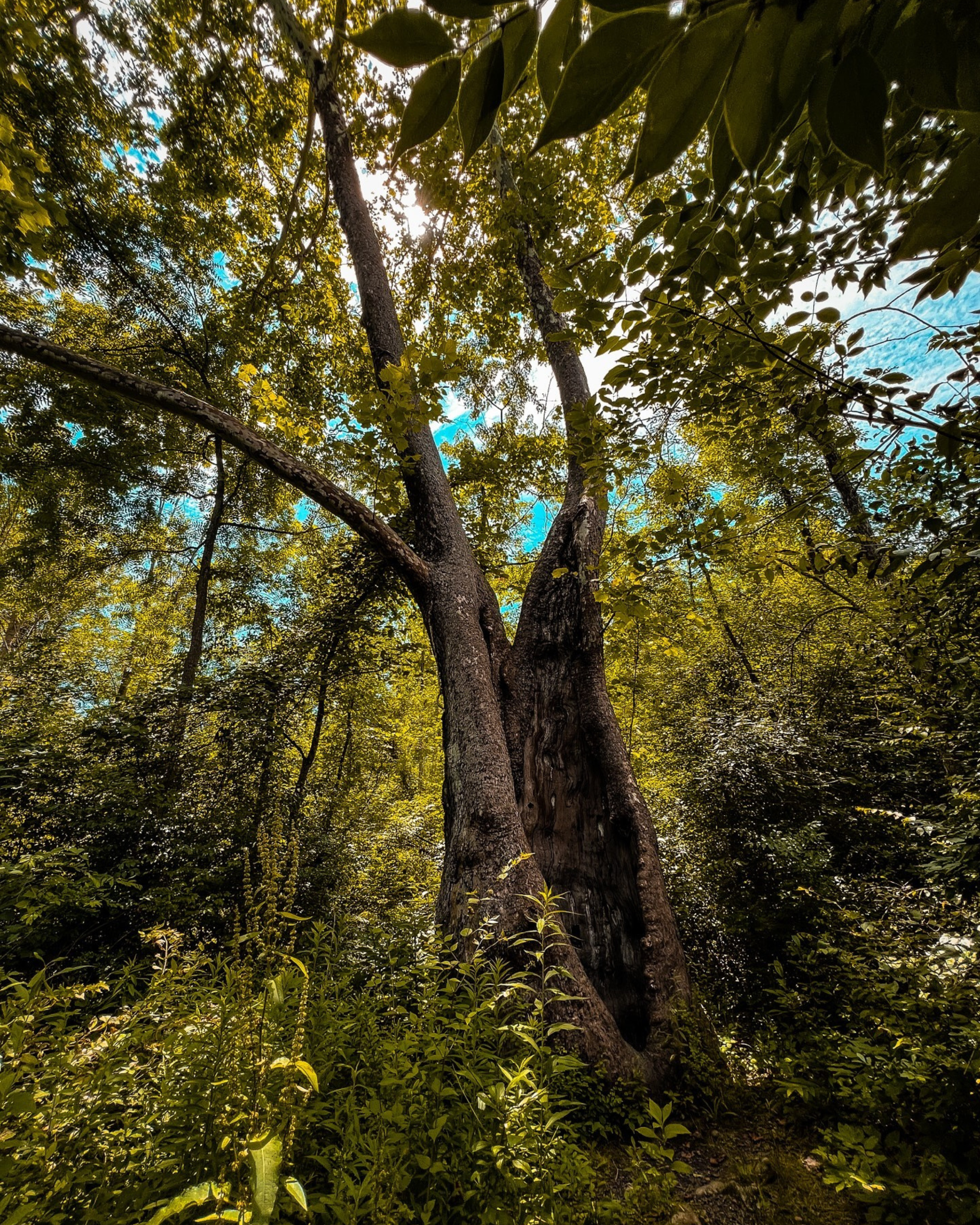
One of the trees identified as a Moses Cleaveland Tree was a sycamore in Cuyahoga Valley National Park, alongside the since-closed Riverview Road extension. The tree is believed to be 350-400 years old, so it would have first planted roots sometime in the 1600s. At the time of the sesquicentennial, its trunk had already been hollowed out by the heart rot typical of old sycamores. You can fit multiple people inside the cavity. Back in the 1930s, according to researchers Becky MacKay and Ryan Trimbath, a young man named Wesley Gaab used to cook hotdogs from inside the trunk, so it’s roomy enough for an impromptu outdoor kitchen.
The tree’s appearance suffered from more than just its rot-hollowed trunk, Several years before its Moses Cleaveland designation, the tree experienced an unorthodox decapitation. Concerned that the branches hanging over the road could be a hazard, locals decided to remedy the matter not with saws but with dynamite. They tried to kaboom the tree into oblivion. They successfully exploded away the treetop, but the hollowed-out trunk remained. The thing is, the walls of that hollowed-out trunk were still alive and well, and of sufficient width to nourish and sustain new growth. The tree sprouted new branches and resumed its rise to reclaim its former glory. It’s now over 100 feet tall and its diameter has grown to 82 inches. The tree had many prior nicknames, but it became known as the Die Hard Tree because it simply refuses to die.
How do you honor Cleveland’s toughness and resilience without evoking tired, blue-collar, Rust Belt tropes? You possess a deep historical knowledge and understanding of your hometown and do it in the most Forest City way imaginable.
*****
The last thing any fan wants is their club’s logo to be a milquetoast mediocrity or a piece of fugly, soulless clipart. Fortunately for those on the North Coast, the Forest City Cleveland crest stands out. The color palette is pleasing and unique within the market, the name has roots in our city’s rich history, and the Die Hard Tree overcomes all adversity and keeps growing into the future. It’s a lovely, meaningful, Cleveland-centric crest that can be worn with pride..
But most of all, I love that Forest City kicks aside common tropes to evoke and celebrate Cleveland’s abundance of natural beauty.
It’s the Cleveland I’ve known.
It’s the Cleveland I see.
It’s the Cleveland I love.
 Sirkbook.com