The last few years, Clevelanders have had many reason to look to the heavens. We’ve witnessed the eerie majesty of a total solar eclipse, ogled the specter of the wondrously luminous northern lights, and had our windows rattled by the hypersonic boom of a wayward asteroid burning its way to a disintegrated crash landing, scattering meteorites in Medina County.
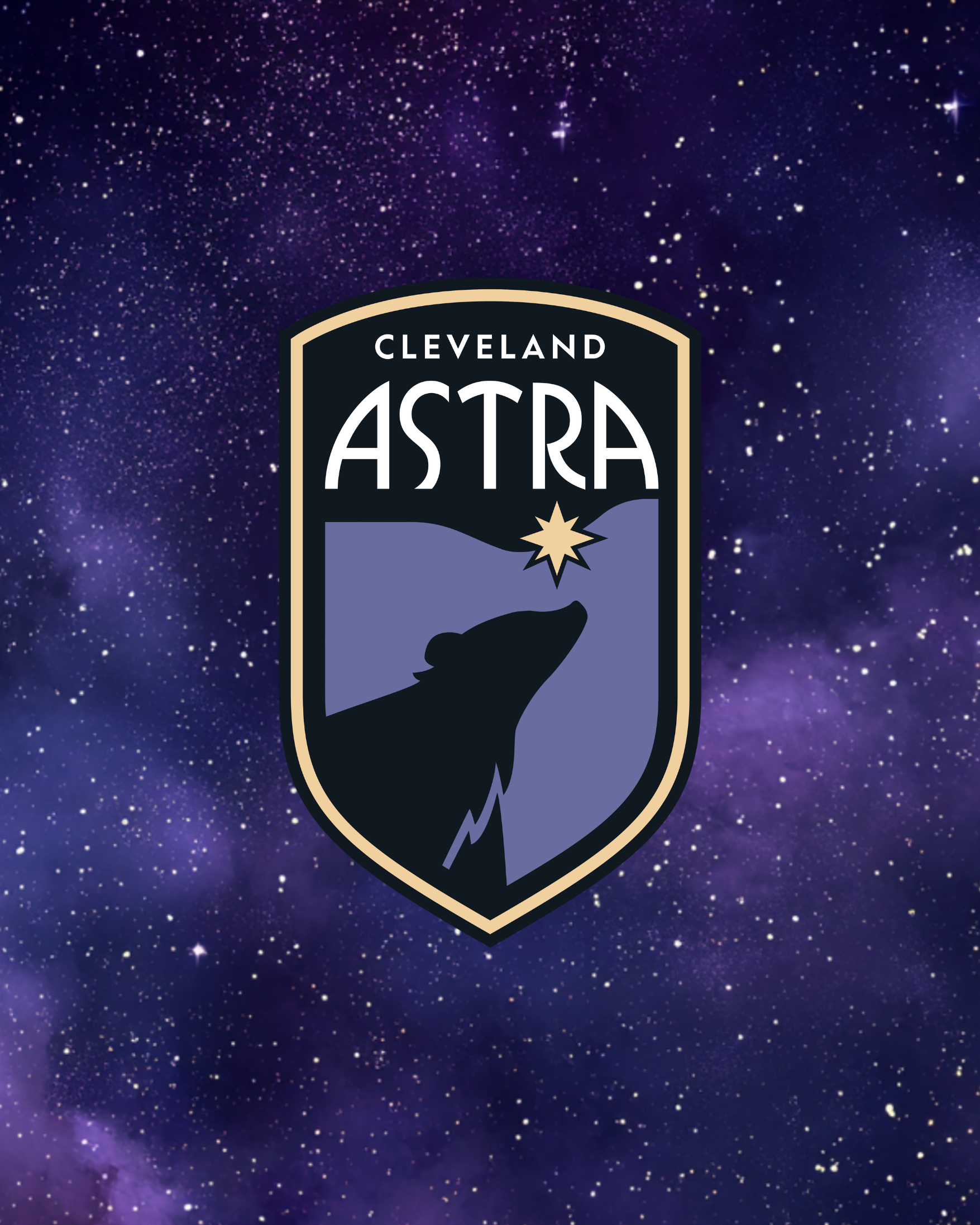
Today marks Cleveland’s most recent celestial-themed event. The city’s women’s professional soccer team will be known as Cleveland Astra.
*******
While not as overtly Cleveland as the Forest City name for the men’s team, Astra is Latin for star, and Cleveland and Ohio are no strangers to space greatness. The state has produced 26 astronauts, including the first American to orbit Earth (John Glenn), the first human to walk on the moon (Neil Armstrong), the first to fly to the moon twice (Jim Lovell), and a pioneer who perished in the Challenger disaster (Judith Resnik.) Including Lovell and Resnik, 12 of the 26 Ohio astronauts were born in Northeast Ohio.
But Cleveland’s space contributions go far beyond astronauts. NASA’s Glenn Research Center is a vital component of America’s space program. It plays a large role in developing the science and technology NASA uses for its space missions. For example, the liquid hydrogen rocket engine and the ion thruster engine were developed here, as was the electrical power system for Space Station Freedom.
In elementary school, we took a field trip to the Glenn (then Lewis) Research Center. They probably regaled us with inspirational tales of their expert advancements in cryogenic fluids management, but what I remember is they gave us astronaut ice cream. I would not recommend it as a concession item at Astra games.
*******
Cleveland’s significant NASA connections notwithstanding, the Astra name and crest germinated from different inspirations and aspirations. Astra was a latecomer in the branding process, and it was not among the finalists that were polled on social media. As the team moved forward with those concepts in the focus group process, Gina Prodan Kelly, Chief Marketing Officer for Cleveland Soccer Group, says they consistently hit a wall.
“The response was generally — yeah, ok, that’s good,” she says. “But ‘good’ is ignorable; it does not kick the door down and say WE’RE HERE.”
Based on additional feedback from follow-up interviews, Prodan Kelly went back to basics in contemplating Cleveland’s monumental moments and history makers.
“So much of what we traditionally think of as tradition, history, brand in Cleveland is… men’s tradition, history, decisions. Aside from the city’s first and only female mayor, Jane Campbell, and figures in Rights movements, we don’t have a storied history that we celebrate that involves women here. Women have certainly been part of it, but we don’t celebrate or often even know about them. So, we decided we had to start creating our own mythology that could eventually help highlight the women who have been part of shaping this region.”
One comment from a focus group participant is something that stuck with Prodan Kelly. Someone told her, “I’m tired of needing to be resilient. I want to have what I need to fly.”
That sent Prodan Kelly looking skyward, but not so far as the cosmos. It would take two other connections to leave the atmosphere.
The first connection was the realization that more than half of the top 25 programs in NCAA Division 1 women’s soccer have players from Northeast Ohio, and there is a growing number of Northeast Ohioans playing the top-flight National Women’s Soccer League, including Brecksville’s Christen Westphal, Lakewood’s Mia Justus, Mansfield’s Taylor Huff, and Katie Scott, who is from western Pennsylvania but played her club ball growing up with Cleveland’s Internationals SC.
“I said out loud… geez, little did you know this is the place stars are made,” she recalls. “We are all but stardust isn’t a dismissive statement. It’s a reminder that we’re not only all connected in some way — but we’re made as the same material as the stars. Stars help us dream, imagine, think bigger than we are. Stars light the way.”
Following that train of thought made Prodan Kelly reflect on the foundational values, mission, and vision of the entire project.
“That brought us full circle to day one for Cleveland Soccer Group,” she says. “Michael Murphy set out for these teams to be the North Star of soccer and women’s sports. We aim to be the guiding light, the standard bearer that wraps our arms around the community and helps us all realize better outcomes.”
The North Star had been there since day one, but it was finally being seen. Once the starry concept took hold, the choice was between Astra and Stella. “Stella is the more common, everyday Latin word for a star,” she explains. “It refers to a star as a physical object in the sky. But astra comes from the Greek astron, and it carries a more poetic, elevated, cosmic register. Astra gestures toward the heavens as a whole: the celestial realm, destiny, the grand sweep of the cosmos.”
Astra won out because it was a grander concept, and because it was a non-English word that was easy to understand across all languages in Cleveland’s multinational soccer landscape. “We thought it was a subtle way to pay tribute to that global element and commit ourselves to multi-lingual marketing and communications to make everyone feel invited, welcomed, and celebrated in our community.”
*******
One person who made everyone feel welcome and invited in our community was Dan Francetic, an astronomy teacher at Euclid High School. Not only did he teach a high school astronomy class, but kids from across the district and the region would visit Euclid’s planetarium on field trips to learn about the science and mythology of the nighttime sky. When I first learned that Astra was a finalist for the team brand, I thought back to those times in the planetarium with Mr. Francetic, both as a child on field trips and as his student in high school.
It turns out I wasn’t the only one. Prodan Kelly is a fellow Euclidian who carried forth her love of astronomy from Mr. Francetic. “Going to the planetarium is one of my favorite childhood memories — I loved learning about the stars and the phases of the moon. I couldn’t get enough of the mythology of the stars. As we recently saw with the Artemis II mission, there’s something about space, the moon, and the stars that brings us all together with wonder, curiosity and dreams.”
Then came the task of translating such heady concepts into a visual brand with creatives Alex Kocher and Mo Fitzgerald.
“With all of that stardust swirling in our heads, we explored a number of visual concepts, including a unique star quilting pattern that related to Northeast Ohio’s role in the Underground Railroad,” she says of the secret network of routes and safe houses that brought slaves from the southern states to the free northern states or, ideally, Canada, using constellations as a navigational tool. Chief among them was the Big Dipper, referred to as the Drinking Gourd, which pointed the way to Polaris, the North Star. The Big Dipper itself is another name for a famous constellation that would become the focus of the club’s branding.
“We went back to that Day One vision… and back to the planetarium with Mr. Francetic. Ursa Major (The Great Bear) wheels around the North Star without ever dipping below the horizon. Its two pointer stars always draw a line straight to Polaris. She’s humanity’s oldest natural compass. We are the North Star and the stars guiding your way to it. I also loved the symbolism of the Great Bear. Bears are a complex symbol of fierce love meets fierce protection and strength. Kind of like a female athlete.”
(There is nothing fiercer than a mama bear protecting her own. One can hope the Ursas will take that energy on the field with them for each and every Astra game.)
With Astra and Ursa Major, it’s a telling tribute that all these years later, two former students of different ages thought of the same teacher. Dan Francetic passed away in 2014 at the age of 81, but to anyone who had the good fortune to set foot in his planetarium, he is an indelible part of the grand sweep of the cosmos embodied by the Astra name.
“Mr. Francetic is the reason I know what Ursa Major is and how to navigate a night sky,” Prodan Kelly says. “May he rest in peace knowing he had a hand in naming a women’s pro soccer team in Cleveland.”
*******
POSTSCRIPT
I am in the final stages of the first of multiple books about the Cleveland Force of the Major Indoor Soccer League, the most commercially successful Cleveland soccer venture to date. The Star Wars themed club with its Darth Vader mascot still holds a special place in the hearts of many Clevelanders who attended sold-out games at the Richfield Coliseum in the 1980s. Accordingly, my brain was primed to notice a subtle connection in Cleveland Soccer Group’s two team brands.
The men’s team is Forest City Cleveland. “Forest” kind of sounds like “Force.” The brands Cleveland Force and Forest City Cleveland are nothing alike and have completely different themes and colors, but there is the faintest audible echo linking Cleveland’s pro soccer past to its pro soccer future.
And now the women’s team is named Cleveland Astra, with Astra being Latin for star. And the brand was unveiled on the unofficial Stars Wars holiday of May the Fourth. (As in a lispy, “May the Fourth be with you.”)
So, one team has a faint semi-soundalike word as part of its name, and the other has a brand based on stars and space that was unveiled on a Star Wars holiday. I felt like I was either a crazy conspiracist in the throes of book-writing psychosis, or these were subtle nods to an entire Cleveland generation’s greatest soccer memories. I had to find out.
“100% intentional,” Prodan Kelly says. “It’s essential to continuously honor, celebrate, and educate people on our Cleveland soccer history. We may be the first to bring women’s pro soccer and the most recent, and hopefully the most successful, to bring men’s pro to Cleveland — but it’s essential to honor what got us here. May 4 was my way of quietly signaling Astra to the people who were in focus groups, give other people an Easter egg to ponder, and give a nod to Cleveland history.”

